

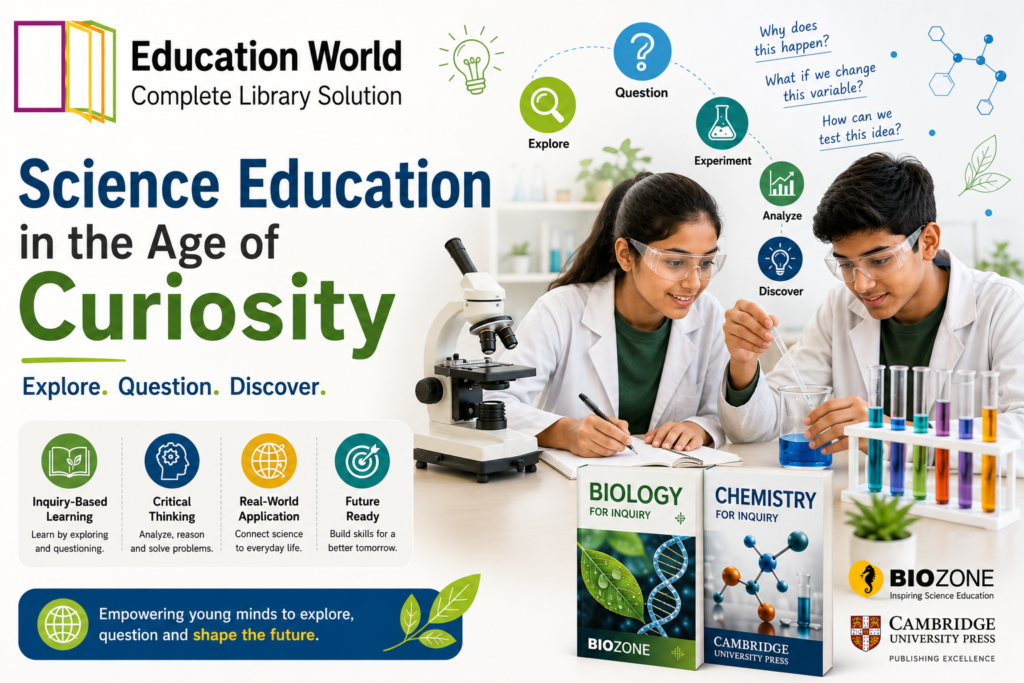
Science Education in the Age of Curiosity
In today’s rapidly evolving world, science education is no longer confined to memorizing formulas or definitions. Instead, it is shifting toward a curiosity-driven approach where students actively explore, question, and experiment. Inquiry-based learning (IBL) has emerged as a powerful method in biology and chemistry classrooms, transforming students from passive learners into active investigators.
This transformation is also reflected in modern educational resources, including Bestseller Books published by organizations like Biozone and Cambridge University Press, which emphasize exploration, critical thinking, and real-world application.
What is Inquiry-Based Learning?
Inquiry-based learning is a student-centered teaching method that encourages learners to ask questions, investigate problems, and construct their own understanding of scientific concepts. Unlike traditional lecture-based methods, IBL focuses on the process of discovery rather than simply delivering answers.
In this model, students:
- Formulate questions
- Design experiments
- Analyze results
- Draw conclusions based on evidence
Research shows that inquiry-based approaches allow students to engage in authentic scientific practices and develop a deeper understanding of concepts.
Why Curiosity Matters in Science Education
Curiosity is the driving force behind scientific discovery. From understanding cellular processes in biology to exploring chemical reactions in laboratories, curiosity fuels innovation.
Inquiry-based learning aligns perfectly with this natural human instinct. Instead of asking “What is the answer?”, students begin to ask:
- “Why does this happen?”
- “What if we change this variable?”
- “How can we test this idea?”
Studies indicate that such approaches significantly improve student motivation, engagement, and conceptual understanding.
Inquiry-Based Learning in Biology
From Observation to Discovery
Biology, as a life science, is inherently suited for inquiry-based learning. Students can observe living organisms, conduct experiments, and analyze biological systems.
For example:
- Investigating plant growth under different conditions
- Studying microbial cultures
- Exploring genetics through simulations
Inquiry-based biology labs help students develop scientific attitudes and confidence, moving them toward expert-like thinking.
Real-World Application
Instead of memorizing diagrams of cells or ecosystems, students engage in real-world problems such as:
- Environmental conservation
- Disease prevention
- Biodiversity analysis
This approach not only enhances understanding but also connects science to everyday life.
Role of Modern Publishers
Educational publishers like Biozone are known for creating biology resources that promote inquiry. Their materials often include:
- Case-based questions
- Data analysis tasks
- Hands-on investigation activities
Such Bestseller Books encourage students to think like biologists rather than just study biology.
Inquiry-Based Learning in Chemistry
Beyond “Cookbook” Experiments
Traditional chemistry labs often follow step-by-step instructions, leaving little room for exploration. Inquiry-based chemistry, however, shifts the focus toward experimentation and problem-solving.
Students might:
- Design their own experiments
- Predict outcomes of reactions
- Analyze unexpected results
This approach helps students understand chemistry as a process of discovery rather than a set of fixed rules.
Research highlights that inquiry-driven laboratory work promotes critical thinking, reasoning, and independent learning.
Developing Scientific Thinking
Inquiry-based chemistry allows students to:
- Understand experimental design
- Recognize variables and controls
- Interpret data effectively
Students often report feeling like “real scientists,” as they actively generate knowledge rather than passively receive it.
Contribution of Educational Resources
Publishers such as Cambridge University Press have developed chemistry textbooks that integrate inquiry-based tasks, including:
- Open-ended questions
- Problem-solving exercises
- Real-world case studies
These resources support teachers in implementing inquiry-based strategies effectively in classrooms.
Benefits of Inquiry-Based Learning
Inquiry-based learning offers several advantages in science education:
1. Enhanced Engagement
Students become active participants, leading to higher interest and motivation.
2. Improved Critical Thinking
Learners analyze, evaluate, and synthesize information rather than memorizing facts.
3. Deeper Conceptual Understanding
By exploring concepts themselves, students retain knowledge longer and understand it more deeply.
4. Development of Scientific Skills
Students learn essential skills such as:
- Hypothesis formation
- Data analysis
- Problem-solving
Challenges in Implementation
While inquiry-based learning is highly effective, it is not without challenges:
- Requires more time than traditional teaching methods
- Demands well-trained educators
- Needs proper classroom resources
Additionally, students may initially struggle without structured guidance, highlighting the importance of a balanced approach.
The Future of Science Education
As education continues to evolve, inquiry-based learning will play a central role in shaping future scientists. The integration of technology, digital labs, and interactive resources will further enhance this approach.
Publishers like Biozone and Cambridge University Press are already leading this transformation by creating innovative learning materials that align with modern pedagogical practices.
These Bestseller Books are not just textbooks—they are tools that inspire curiosity, foster exploration, and prepare students for real-world scientific challenges.
Conclusion
Science education in the age of curiosity is about more than just acquiring knowledge—it is about developing the ability to question, explore, and innovate. Inquiry-based learning in biology and chemistry empowers students to think critically, engage deeply, and act like scientists.
By embracing this approach and utilizing high-quality resources from leading publishers, educators can create classrooms where curiosity thrives and learning becomes a journey of discovery.
Science Education in the Age of Curiosity Read More »